Showing posts with label Language. Show all posts

Sunday, November 29, 2009

Culture and Collaboration, an explosive mix

Saying that Italians, French, German and Dutch people react differently is an understatement. We all have our stories of culture clashes. Our colleagues in different countries do not behave exactly like us. Although we probably share the same organizational culture, our cultural background makes us approach events and situations differently. This often make our colleagues blink, as they do not understand our reactions. Particularly in large global organizations, collaboration is hindered by these elements, without being taken care of.

When I started working with Indian colleagues, I quickly got completely confused. Not only did they shake their heads strangely, they also told me they would do something and did not do it. Actually, my statement is NOT correct. I should say I understood they were going to do something because they answered “yes” to my question. My assumption became my reality within the frame of my own cultural value system. Much later I understood, India had a different value system. As one of my Indian friends one day told me, “there are 40 ways to say yes in Hindi, there is no way to say no”. They had responded candidly to my question, with what in their eyes meant something like “yes, I hear what you say”. They were sincerely astonished when, one week later, I imageexpected a deliverable.

This example demonstrates the misunderstandings happening daily in large enterprises. The more globalization moves to the east, the more we encounter such issues. Employees are not prepared for such challenges. I found the image hereby, based on work performed by Huntington an interesting starting point, although I believe in differences between ethnic groups within the areas.

When working in an international environment it is impossible to understand all cultures we are confronted to, However, building cultural awareness is important to avoid clashes and misunderstanding in the first place. Cultural sensitive people will be less astonished about unusual responses and try to understand what is happening rather than reacting negatively. Achieving this is already great progress for collaboration as it allows the people to openly discuss their differences and explain why each  member behaves the way he/she does. Let me finish this note with a small example. When I started working globally, I received the name of a contact in Japan. I called him up, as a good European, telling him I wanted to ask him a couple questions. He responded “please send your questions in writing”. This drove me nuts. Who did he think he was? Was I not good enough to be allowed to talk to him? I actually was so angry I talked about it with my boss. He explained that the Japanese person was far from excellent in English. As he did not want to loose face by giving me a wrong answer, he asked me to send my questions in writing. This would allow him to use his translation tools to ensure he understood exactly what I needed and provided the best answer. This was a lesson I never forgot. Lets not look at the reaction from the other through our own lenses, but rather try to understand what the reaction actually mean. Much later, when I had build a relationship with him, I had the opportunity to discuss this “near incident” with him. We had a real good discussion, it helped us to understand each-other better and to become friends. If the reaction of one of your foreign colleagues drives you creasy, it may be time to try to understand rather than judge.

Sunday, January 18, 2009

Where there is a Will, there is a Way

Today I’d like to share an experience which is a little different from the ones I shared up till now on this blog. Indeed, over the Christmas period there was a large religious event in Brussels. It was the international pilgrimage of Taizé, stopping for the year-end in Brussels. 40000 young people from all over Europe and from a variety of Christian religions converged to Brussels for a three day event consisting in prayers, workshops, meetings and being together.  We got involved through our parish as they were looking for households to provide space for the people to sleep. Speaking English, I was asked by my neighbors to serve as a translator, and having some space at home, we welcomed a couple polish people. She spoke some English and he a little German. But we got along quite well.

Taizé 2009 In pour parish, we welcomed 20 Italians, 20 Serbs (some of which actually turned out to be Slovaks) and 20 Polish people, a couple of which actually came from Ukraine and a couple other countries. A nice melting pot of languages, cultures, religious and historical differences. Reviewing those couple days, it was actually a great success, despite the difficulties in communication. People were constantly speaking in 3 or 4 different languages, with translation from Serb to Slovak to Polish for example.

Experiencing this, I was thinking back on a number of those international meetings I assisted over the years, where professional translators need to be hired, or where people expect you to speak to them in their language or will refuse to listen to you. What was the difference. here we had people from all over Europe coming with the intention to live something together. Silence, songs (and I believe, despite my awful track record in singing, I must have sang in 8 or 10 different languages over those days), and eagerness to learn to know and understand others better made the difference. And, as somebody told me, if the words could not be understood, gestures and drawings did the rest.

I believe we can learn something important from such an event. Where there is a will, there is a way. Indeed, its by being open and eager to understand the other, his/her standpoint that communication can truly take place. But how often are we blocked by feeling we are the customer and the other should adapt to us. How often are we in a one-way street. That’s our problem. So, lets take a lesson from those 40000 youngsters who are the Europe of tomorrow.

Thursday, September 4, 2008

Can you beat up your customer

In the last couple entries, I spoke about the cultural differences between the Dutch and the Belgians, let me stay on that topic as it allows me to illustrate even more why we cannot take things for granted.

Several years ago, I was asked by one of our sales people to join him in a sales call to his Dutch customer. This was actually my first sales call in the Netherlands and I accepted it immediately. I thought it might be interesting, it actually was, way beyond my expectations, but for completely different reasons.

After the check-in at reception, we were guided to our clients office and sat down in front of him. My colleague introduced me, up till then, nothing unusual. But he turned back to his client and told him in non uncertain terms, he was completely pissed of with him because he had not placed the order he had promised and as such, my colleague had missed his forecast. Obviously, the client did not take that and the discussion heated up quite heavily. I was sitting on my chair completely frozen and asked myself how soon we would be thrown out. I could not understand why he was risking the whole relationship for what turned out being a small delay due to someCRW_0380 administrative issues. The bashing lasted for about one hour. When they finally came to an agreement and the customer apologized (believe me or not), he turned back to me, and as it was already late afternoon, told me, "look I want to hear what you have to tell me, why don't we go and take a drink in a nearby bar. This will allow us to talk more freely." And yes, the customer even paid for the drinks.

The Dutch have this great capability to completely separate business and private life. It is not because you have an issue on the business side, that this will affect your personal relationship. This is actually a great asset, but that got me shivering before understanding what it was all about. Never take things for granted, make sure you get briefed on how business is done in a country prior to go to the first customer meeting. I can tell you out of personal experience. Do you also have such stories to tell?

Wednesday, August 20, 2008

A little more on culture

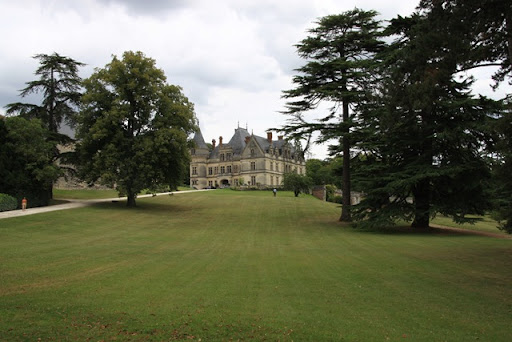
Last week my wife and I went cycling in the Loire valley in France and obviously, visited some castles. What else can you do out there, isn't it? Each castle has its way to represent its history. In one of them, plastic sheets were available for the visitors in each of the rooms. Several languages were provided, they included beside French, English, Italian, Spanish, German and a couple sheets in Dutch. I was actually quite impressed about the number of languages available and the effort the French owner had mad to translate the text. So, when I heard a couple Dutch speaking people complain about the fact there were not enough Dutch documents.

Later in the day, we were lunching in a lonely spot along the river when a group of Dutch speaking people choose a spot 50 cm from our place to have a noisy lunch with their family. Then it daunted on me. Despite the fact we are living within a distance of a couple hundred kilometers from each other, we have very different sensitivities. I IMG_2040 would have been pleasantly surprised to find a text in my language all together, and I try to respect people's intimacy. But that is probably not something I share with some Dutch at least.

Now, if we are already so different, while living so closely, what about the differences of sensitivities with people living on the other side of the planet.

Friday, August 8, 2008

Messieurs les Anglais, tirez les premiers....

No, you are not looking at the wrong blog. This title, that is well known in France, can freely be translated in "Mr. Englishmen, please shoot first...". It goes back to the time of the archeries.

Now, why use this as a title. Well to highlight another aspect of global collaboration. English is the only language that is spoken more by non native speakers than by native speakers. It is actually a very rich language which has a lot of nuances. Listening to British humor is one of the best ways to experience that. Unfortunately, most of the non native speakers do not know these nuances and will make mistakes all the time. Messieurs les Anglais, keep that into account and do not get upset when you hear something that may sound rudeIMG_0072_edited-1 .

I remember, years ago, I was responsible for the beta test of a product that my company was going to sell. We tested the product with a local company in Belgium. The development team, based in the US, was asking for our feedback. And we gave them feedback:

  • You must include this function
  • You must change the human interface in this way
  • You must interface with this device

You probably already realize what happened. We completely pissed of the development team. When I went to visit them, they beat me up. You cannot tell us what we have to do. We should have used other words. We did not realize that the word "must" has a much harder meaning in English than in Dutch or French.

My request is actually pretty simple. Keep in mind that not everybody you talk to is as fluent as you are in English. It may avoid a lot of bad feelings.

Wednesday, July 9, 2008

Understand the language

I am currently in Kuala Lumpur and this morning we had a conference call with a customer in China regarding a project they were asking our advise on. The discussion was held partly in English, partly in Cantonese. Frankly, my knowledge of Cantonese is zero, or even worse, which means I did not get anything of what was said in that language. Fortunately, I had with me in the room one of my friends who can understand the language reasonably well.

This sounded invaluable, as it allowed me to assess more or less the thinking and feeling of the customer. Not being able to see him, it is important for me to understand how what I am saying is actually coming over. In some cultures, and when you know the language, you can assess that from the tone used. Unfortunately, when things just sound as a series of sounds without any meaning to you, it is very difficult to assess things.

That's the reason why it is of the uttermost important, when holding such discussions, to have somebody with appropriate language (and culture) understanding to keep you on the right track. And it needs to be a person you can trust. Particularly with Asians, that are very good at not showing their emotions, having such an ally is critical for any serious negotiations. Here again, I can HPIM5074_edited-1only stress the importance of gaining a good understanding of what is in the mind of the person at the other side of the line. Keep that in mind when having discussions over long distances. Otherwise, you will be flying blind and may end-up in completely the wrong place. Remember this old Chinese proverb (actually this is how it was explained to me) "If you do not know where you are, no map will help"